
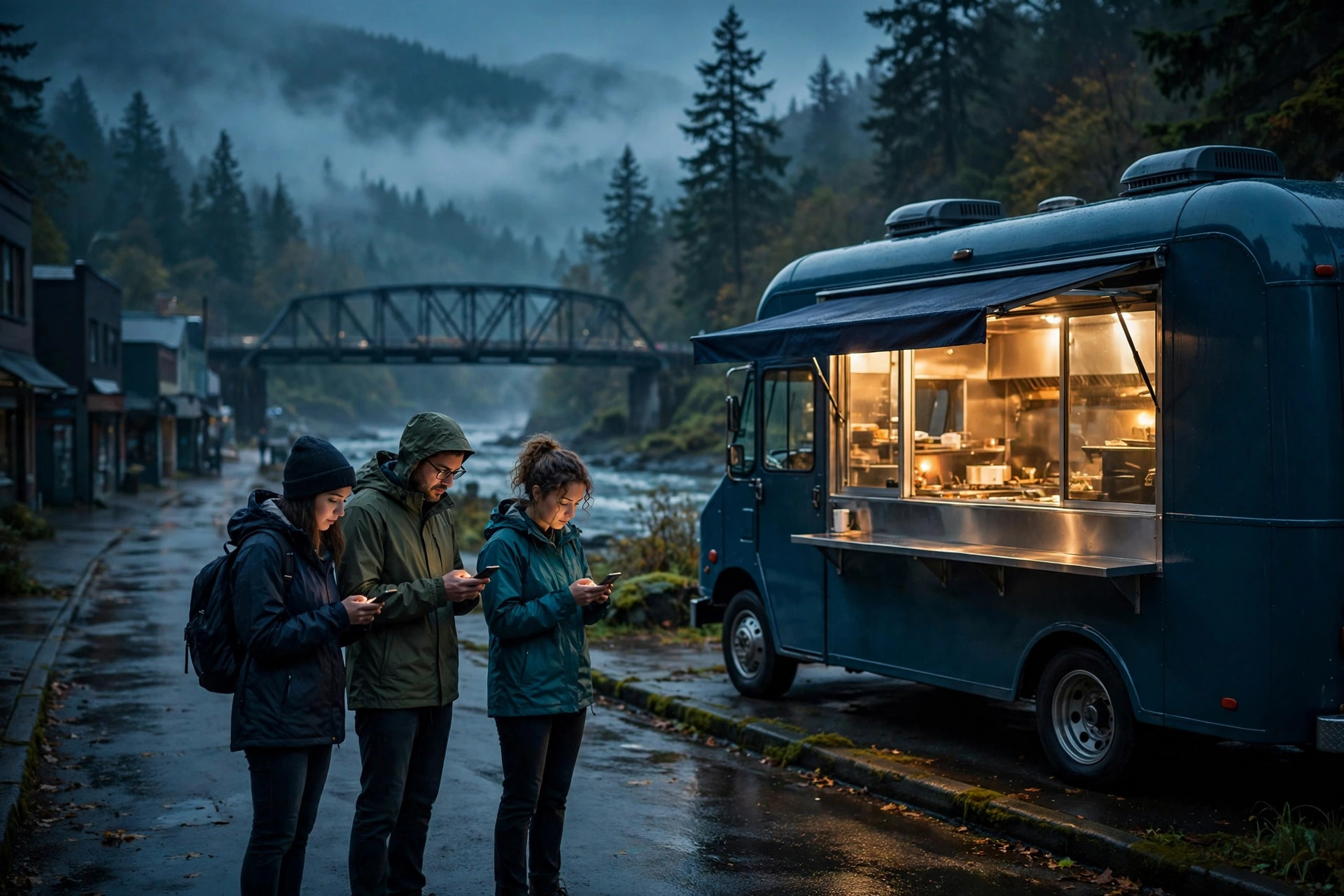
A restaurant's customers know where it is. A food truck's customers have to figure it out fresh every single day. Your regulars might check your Instagram story. The office worker two blocks from today's spot, the family driving through Pasco, the coworker organizing a lunch run — they do not follow you. They search. If what they find is yesterday's location, an old schedule, or nothing at all, you lose a customer you never knew you had.
Washington now has a Food Truck Finder — be on it
The Washington State Food Truck Association recently launched the Washington State Food Truck Finder, a statewide platform built so customers can track food trucks in one place. As Food Truck Operator reported in October 2026, the association built it with Victory Tech Solutions, and truck profiles on it can carry your location, menus, social media links, online ordering, events, and photos.
The association's own director, Lori Johnson, put the reason plainly: food trucks are always on the move, and figuring out where a favorite truck will be today has always been one of the biggest challenges for customers. That is the problem the Finder exists to solve. Claiming and completing your profile there — current location, real menu, good photos — is the single easiest new place for Washington customers to find you. It only works, though, if you keep the profile current. A finder listing showing last month's spot is worse than useless; it sends a hungry customer to an empty curb.
Your own website needs a "where we are today" block
Directories like the Finder are rented ground. Your website is the one place online that you control, and for a food truck it has one job above all others: answer "where are you today?" in the first screen, before anything else. Build it like this:
- A today-location and weekly schedule block at the top of the home page — today's spot and hours first, then the week's regular stops. It has to be easy to update from your phone in under a minute, because a schedule block you dread updating will quietly go stale.
- Your full menu with prices. Customers deciding between you and the truck across town are comparing menus, not logos.
- A catering and private-events form. Weddings, company lunches, and brewery nights are the highest-value bookings a truck gets, and they start with an inquiry, not a walk-up. A simple form — date, location, head count, contact info — catches them while you are mid-service.
- Tap-to-call and directions buttons on every page, because nearly all of this traffic is on phones.
One discipline makes all of this manageable: treat your website as the single source of truth. Your Finder profile, your Google profile, and your social bios should all point back to it. When the schedule changes, you change it in one place, and every customer who follows any link lands on the current version. Owners get in trouble when the truth is scattered — the Instagram bio says one thing, the Google hours say another, and the truck is somewhere else entirely. One source, kept current, beats five profiles kept approximately.
Keep your Google profile working as hard as your schedule
When a stranger searches "food truck near me" or "tacos Pasco," Google Maps is usually the first thing they see. Keep your Google Business Profile honest and current: your service area, your hours, and a Google post when you are somewhere special — a festival, a new regular spot, a one-day event. Your profile will not show a different street address every day the way your website can, which is exactly why the two work as a pair: Google gets you considered, your website's schedule block closes the sale. The Maps basics we laid out in How Barbershops Show Up on Google Maps — accurate categories, hours, photos, reviews — apply to a truck the same way they apply to a shop with a fixed address.
Social media helps followers. Search finds strangers.
Posting today's location to Instagram and Facebook is worth doing — your followers are your regulars, and regulars are gold. But be clear-eyed about the limits. A story disappears in 24 hours. A post reaches only people who already follow you, and only some of them. Nobody planning lunch in a part of town they do not know opens Instagram hoping a truck mentioned being there. They open Google, Maps, or a finder. Social is how your fans keep up. Search is how new customers find you at all. A truck that only posts its location to social is invisible to everyone who has not already eaten there.
A simple routine that keeps all of it true
Once a week
Update the schedule block on your website and your Food Truck Finder profile with the week's stops. Five minutes, same time every week.
Each morning you roll out
Post today's spot to social, and check that your Google hours still match reality — especially for event days and weather changes.
When plans change mid-day
Sold out, moved, or rained out? Update the website block first. It is the one source every other link points back to.
None of this takes more than a few minutes a day. What it takes is the pieces being in place — a website built for a moving business, a claimed finder profile, and a Google profile someone tends. If keeping the website side current sounds like one job too many, that upkeep is exactly what a care plan covers; we explain what that kind of maintenance should include in What Website Maintenance Should Cost a Small Business.
We build food truck websites with the schedule block up top, the menu where people expect it, and a catering form that works while you are on the line. You see a free concept before you pay anything.
Request a free conceptFood truck location FAQ
Do I still need my own website if I am on the Food Truck Finder?
Yes. The Finder is a directory listing — a good one, and you should claim it. But it is rented ground with limited room. Your website carries your full menu with prices, your catering form, and your schedule in your own words, and every other profile you own can point back to it. If a platform changes its rules or shuts down, your website is still yours.
How often do I need to update my location?
Every time it changes — and if you hold regular weekly stops, publish the recurring schedule once and then only post changes, special events, and holiday hours. The goal is that a customer checking at 11 a.m. never sees where you were yesterday.
What belongs in a catering inquiry form?
Keep it short: name, phone or email, event date, event location, estimated head count, and a notes box. Catering leads are valuable and the person asking is usually comparing two or three trucks — a form that works on a phone, answered the same day, wins more of them than a 'DM us' note.
Can customers order ahead for pickup at the truck?
Yes — online ordering on your own website lets customers order and pay before they arrive, which shortens your window line at the lunch rush. We compared that with the delivery apps in Restaurant Online Ordering vs. DoorDash.
Want a website your customers can actually find?
Tell us about your truck and we will show you a free concept with a today-location block, your full menu, and a catering form — before you pay anything.
Your truck moves. Your website should keep up.
Nova Pulse Media builds food truck websites for Tri-Cities owners — $300 setup, $99/month care plan, and a free concept before you commit.