
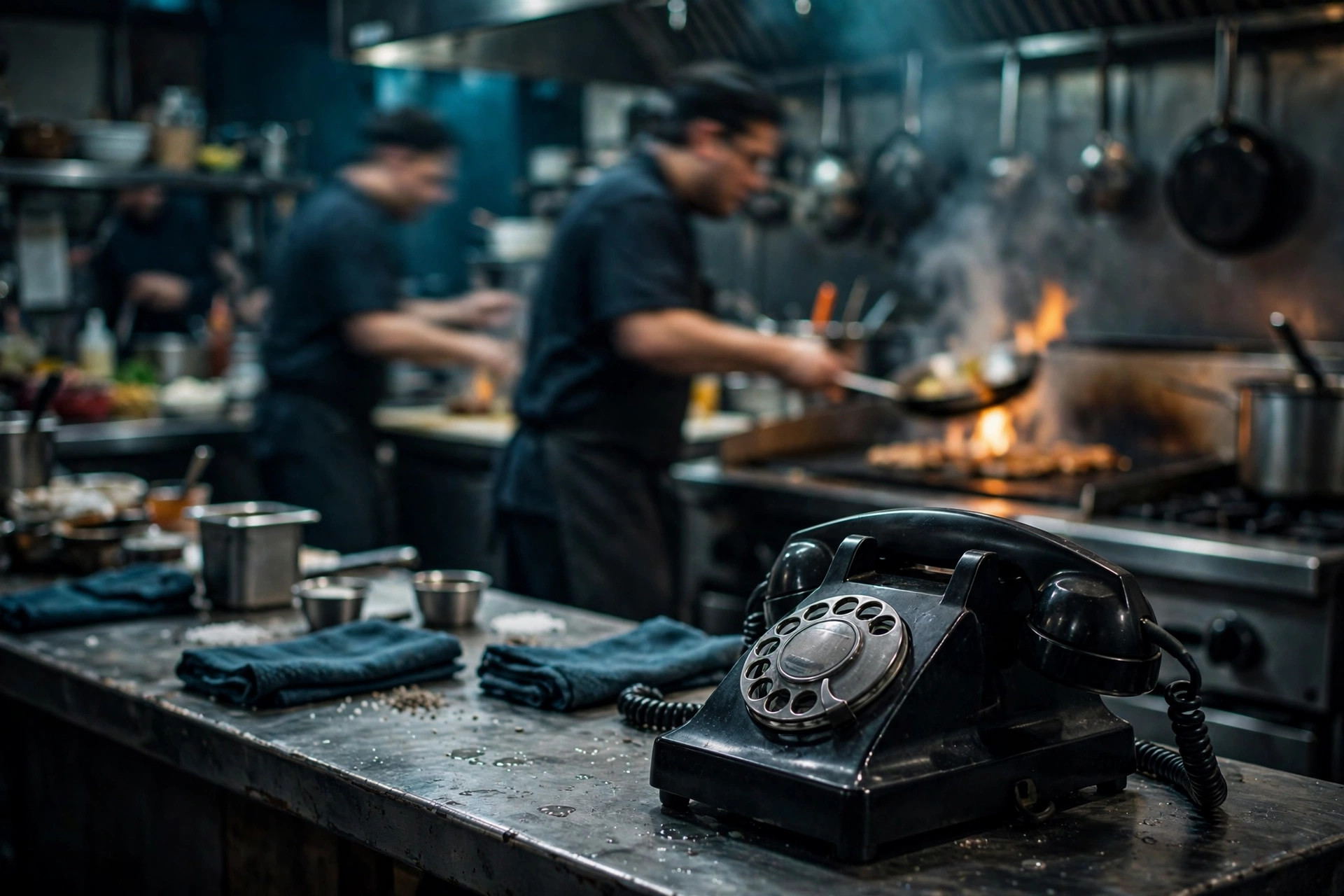
Every restaurant has the same problem at the same time of day. The ticket rail is full, the fryer is going, there is a line at the register — and the phone starts ringing. Somebody has to stop cooking, serving, or bagging food to answer it, or nobody answers it at all. Most owners know this happens. Fewer have stopped to add up what the unanswered calls are worth.
The rush is exactly when the phone fails
This is not a guess. Revmo, a company that sells AI phone-answering services for restaurants, published a report called the State of Restaurant Calls 2026 based on recordings of 12,091 real restaurant phone calls. Because Revmo sells a fix for this problem, treat it as a vendor study — but the calls themselves were real, and the pattern matches what any owner sees at 6 p.m. on a Friday.
In that analysis, quick-service restaurants missed 40.1% of their calls. Fast-casual restaurants missed 24.8%. Full-service restaurants did better at 9%, and pizza places — built around the phone — answered 93.1% of calls. The report also found that fast-casual phone service falls apart hardest at dinner: greeting consistency dropped 38 points from lunch to dinner, and wait times rose 31%. In plain terms, the busier you are, the worse the phone gets — which is exactly backwards, because the busy hours are when the calls are worth the most.
What a missed call usually was
A ringing phone during service is rarely a survey or a sales pitch. It is usually one of these:
- A takeout order. This is the big one. The customer is hungry, decided, and ready to pay. If nobody picks up, most do not leave a voicemail — they call the next place on the list.
- A reservation or a big party. A table of ten for Saturday, a team dinner, a birthday. One call like that can be worth a whole slow Tuesday.
- A catering question. Office lunches and events start with a phone call because the order is too big for a standard menu form.
- A simple question. Are you open? Where are you parked today? Do you have the special? These should never need a human at all — your website and Google profile should answer them before the phone ever rings.
Revmo estimates the missed calls cost an average quick-service location about $73,000 a year. That is their estimate for chain restaurants with chain call volume, and a small Tri-Cities restaurant should not expect a number that size. But the direction of the math is the same for everyone. Run your own version: if your average takeout ticket is $25 and you miss just two order calls a week, that is roughly $2,600 a year walking to a competitor — before catering calls and big parties enter the picture. Your numbers will differ. The leak is real either way.
Voicemail does not rescue many of these calls. A hungry customer who reaches a recording usually does not leave a message and wait — they hang up and order from whoever answers, in person or online. By the time someone on your team checks messages after the rush and calls back, dinner has already been decided. That is why the fix is not "try harder to answer." Your team is already working. The fix is to give the order a path that does not run through a ringing phone at all.
Fix one: let your website take the order
The cleanest fix is to give the customer a way to order that does not depend on anyone picking up. Online ordering on your own website takes the order, takes the payment, and sends it to your kitchen the same way whether it is noon or the middle of the Friday rush. The customer never hears a busy signal, and your staff never leaves the line.
This is not theory for us. In its first 6 days live, the new Antojos 509 website had 202 visits and 13 taps on its order button. People will order from a restaurant's own site when the button is right there and easy to use. If you are weighing your own site against the delivery apps, we compared the two in Restaurant Online Ordering vs. DoorDash — the short version is that the apps charge for the customers they bring you, while orders through your own website carry no marketplace commission.
Fix two: stop the calls that never needed a human
Some of your call volume is people asking questions your online presence should already answer. Keep your hours, location, and menu current on your Google Business Profile and your website, and put the basics where a phone user sees them in seconds: open or closed right now, today's hours, the menu, and a tap-to-call button or an order button. Every "are you open?" call you prevent is a line your staff can give to the calls that actually need a person — the catering question, the allergy question, the big reservation.
Fix three: AI phone answering exists — we do not sell it
You will also see services, Revmo included, that answer your phone with an AI voice agent that can take orders and bookings. Nova Pulse Media does not sell one, and we are not going to pretend otherwise. If your call volume is high and your missed-call problem survives the first two fixes, pricing one out is a reasonable business decision — that is a separate purchase from a website, from companies that specialize in it. What we build is the website side: the ordering, the information, and the booking links that mean fewer calls need answering in the first place.
Check one week of your phone or carrier call log and count the unanswered calls during service hours. Then tell us the number — we will show you a free concept of a site built to catch those orders, before you pay anything.
Request a free conceptMissed call FAQ
How do I find out how many calls I am missing?
Start with your phone bill or carrier call log, or the call history in your phone system if you have one. Count the unanswered calls that came in during lunch and dinner service for one normal week. That number — not a national study — is the one worth acting on.
Is ordering through my own website better than DoorDash?
They do different jobs. The apps bring you their customers and charge commission for it. Your own website takes orders from people who already chose you, with no marketplace commission on the order — card processing fees still apply, as they do everywhere. We compared both in Restaurant Online Ordering vs. DoorDash.
Can't I just put another employee on the phone?
You can, and for catering calls and big reservations a human is still best. But the rush is only a few hours a day, a phone staffer costs payroll in exactly your busiest hours, and a website takes orders at 9 p.m. and on your closed day for pre-orders too. Most small restaurants get more from fixing the website side first.
What does it cost to get a website that takes orders?
A Nova Pulse Media website is $300 one-time setup plus a $99 monthly care plan ($990/year option available), and we show you a free concept before you pay. If you want the full pricing picture first, read How Much Does a Small Business Website Cost in Kennewick, WA?
Want the orders your phone is missing?
Tell us about your restaurant and we will show you a free concept of a website that takes orders when the phone can't — before you pay anything.
Your kitchen is busy. Your website shouldn't be.
We build restaurant websites for Tri-Cities owners that put ordering, hours, and location one tap away — $300 setup, $99/month care plan, free concept first.